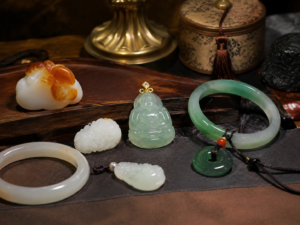


Jade shapes and meanings travel together: in Chinese carving, the form is the message. A blank plaque wishes you an uneventful life; a round buckle wishes you safe passage; a gourd wishes you plenty. This glossary explains the shapes you will meet in our studio and across the jade world — what each one is, what it says, and who tends to wear it.
Wushi plaque (无事牌) — “may nothing happen”
A rectangular tablet, deliberately plain or nearly so. The name is a quiet pun: wu shi, “no incident” — a wish for a life free of trouble. The blankness is the point; the stone carries the meaning without illustration, which is why the Wushi plaque demands better material than almost any other form. Flaws have nowhere to hide on an empty surface. Worn as pendants and, in smaller cuts, as earrings, it suits people who like their symbolism understated.
Pingan buckle (平安扣) — safe passage
A disc with a round hole at its centre — jade’s simplest and perhaps oldest protective form, echoing the ancient bi disc. Ping’an means peace and safety; the buckle is the classic gift for travellers, new drivers, students leaving home, anyone you would like returned intact. Its geometry flatters translucent stone: light passes through the thin walls and the piece seems to hold a glow. Worn by everyone, given by everyone.
Banzhi (扳指) — the archer’s ring
A broad cylindrical ring, descended from the thumb ring that protected archers drawing a bowstring, later adopted by Qing officials as a mark of standing. Today it is jade’s most masculine silhouette — substantial, plain, worn on the thumb or forefinger, or hung as a pendant. A Banzhi asks for even colour and a calm surface; like the Wushi plaque, it has no carving to distract the eye.
A note on Wuji (乌鸡) — a stone, not a shape
One term worth keeping separate: Wuji (乌鸡) — “black chicken,” after the black-boned silkie — names a material, not a form. Wuji jadeite is the ink-and-smoke stone: grey to near-black, rich in omphacite, its colour moving through the piece like ink in water. A “Wuji plaque” in our shop is therefore a plaque cut from Wuji stone, while the blank Wushi plaque above is a shape that can be cut from any material. Two words, one syllable apart, doing entirely different jobs.
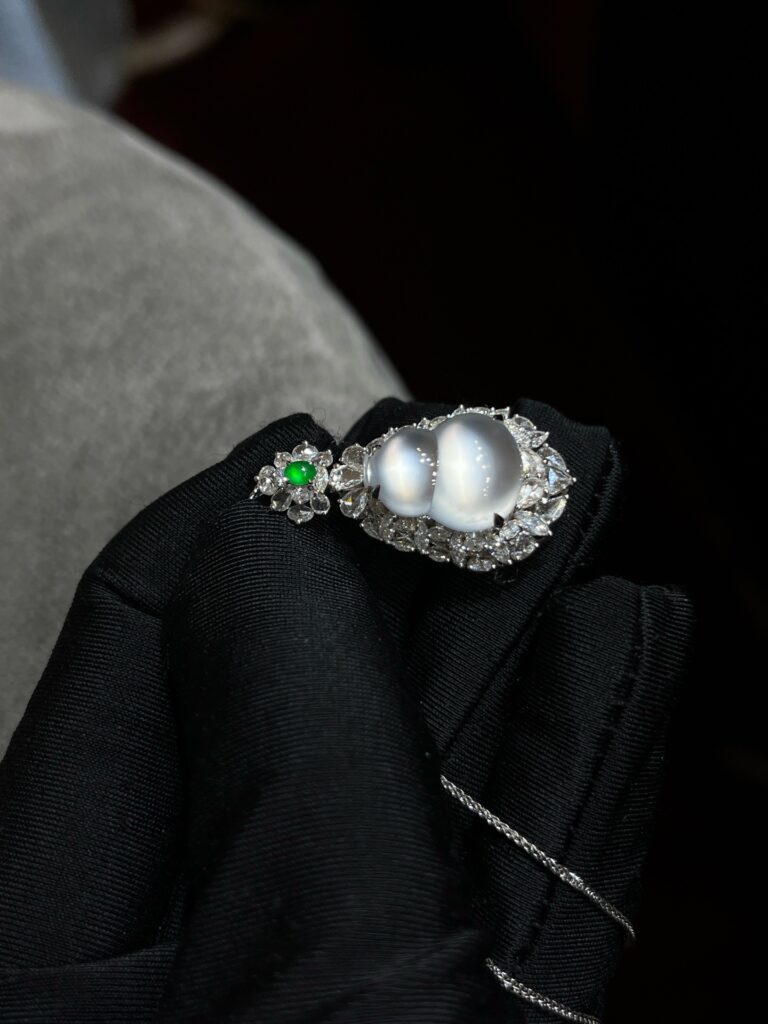
The gourd (葫芦) — abundance
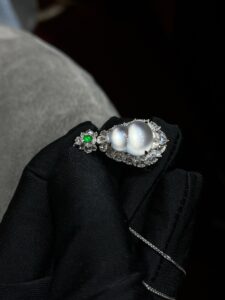
The double-lobed hulu sounds like fulu — fortune and prosperity — and its many seeds made it an emblem of plenty and of generations to come. A rounded, friendly form, often small, often worn daily. Gourds forgive lively stone: a drift of colour through the lobes reads as vitality rather than distraction.
The lotus (莲) — calm out of mud
The lotus rises clean from muddy water, which made it Buddhism’s image of purity kept in an impure world. In jade it appears as leaf, bud or seed-pod, and often puns on lian — continuity, “year after year of plenty.” A lotus carving rewards translucent, watery material; the subject and the stone describe each other.
Beasts, Buddhas and the rest
Beyond these five you will meet the Buddha (laughing Maitreya, for ease of heart), the ruyi sceptre (“as you wish”), the pixiu (a wealth-guarding beast), and the twelve zodiac animals. The grammar is always the same: a homophone, a legend or a virtue, carried in stone. When a motif is unfamiliar, ask what it sounds like in Chinese — the answer is usually the meaning.
Reading a shape before you buy
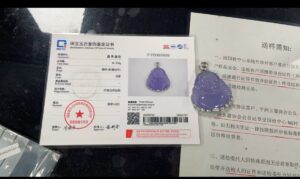
Two practical notes. First, plain forms — Wuji, Pingan, Banzhi — expose the stone completely, so judge the material hard: colour, translucence, texture. Second, carved forms can legitimately use carving to work around a natural inclusion; that is craft, not deception, but the certificate should still say Type A, untreated. Every piece in our jadeite pendants collection ships with NGTC paperwork, whatever its shape. For bangle silhouettes — Round, Half Round and the oval Guifei — see What is a Guifei bangle.
Frequently asked questions
Do I have to match a shape to my zodiac or beliefs?
No. The meanings are wishes, not rules — most people simply choose the form they find beautiful, and let the blessing come along for the ride. Gift-giving is where meanings matter most: a Pingan buckle for a traveller lands differently than a random pretty stone.
Which shape is best for a first piece of jade?
The Pingan buckle is the traditional answer — universal in meaning, comfortable to wear, and kind to a modest budget because thin walls make the most of translucent stone. A small gourd or lotus is an equally good beginning.
Is a plain plaque worth more than a carved piece?
Shape alone sets no price. But because plain forms require cleaner material, a fine Wuji plaque often costs more than a carved piece of the same size — you are paying for the stone’s nerve to stand unadorned.