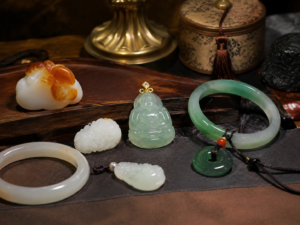


Jadeite vs nephrite is the oldest confusion in jade, because both are honestly called jade and yet they are different minerals with different characters. Jadeite — feicui (翡翠), the Burmese stone — is a pyroxene: denser, harder, capable of glassy translucence and the vivid greens and lavenders the auction world knows. Nephrite — the classical jade of China, finest from Hetian — is an amphibole: slightly softer, felted in structure, prized for a warm, muttony glow rather than brilliance. Neither is the “fake” one. They are two stones, two aesthetics, two histories.
Two minerals, side by side
| Jadeite (翡翠) | Nephrite (和田玉) | |
|---|---|---|
| Mineral family | Pyroxene | Amphibole |
| Hardness (Mohs) | 6.5–7 | 6–6.5 |
| Density | ≈ 3.3 | ≈ 2.95 |
| Structure | Granular, interlocking crystals | Felted fibres |
| Best light | Glassy to icy translucence | Soft, waxy “mutton-fat” glow |
| Signature colours | Imperial green, apple green, lavender, icy white, honey, black | White through cream, spinach green, grey-green |
| Principal source | Myanmar (Burma) | Hetian (Xinjiang), also Russia, Canada |
How they look and feel apart
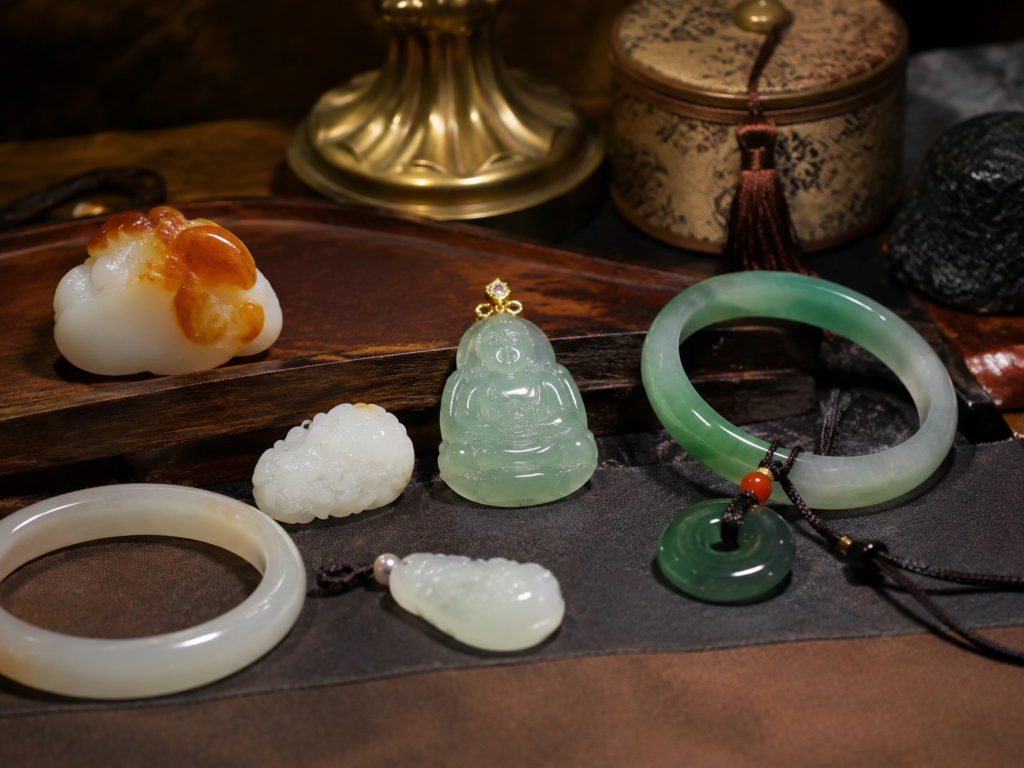
Hold the two and the difference explains itself. Fine jadeite behaves like coloured water — light enters, moves, and comes back out; the surface takes a sharp, glassy polish. Fine nephrite behaves like candlelight through wax — light is absorbed and returned as a soft interior glow; the polish is gentle, almost oily, and the stone feels warmer and lighter in the hand (that density gap is real enough to notice). Jadeite’s colour arrives in vivid, sometimes dramatic drifts; nephrite’s virtue is evenness — the ideal Hetian white is praised precisely for having nothing to point at.
Two histories, briefly
Nephrite is the elder: the jade of Chinese ritual discs, seals and scholar’s objects across several thousand years — “the fairest of stones” in Confucius’s telling, carrying the virtues of benevolence and integrity. Jadeite is the brilliant newcomer, arriving from Burma in quantity only in the Qing dynasty, where the court — the Empress Dowager Cixi above all — fell for its colour and made feicui the imperial fashion. That is why your grandmother’s heirloom seal may be nephrite while her bright green bangle is jadeite; the two stones share a word and a civilisation, not a geology.
Price, plainly
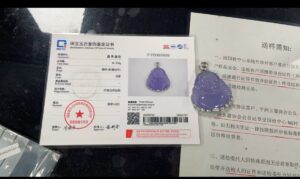
At the top, jadeite is the more expensive stone by an order of magnitude — imperial-green Burmese jadeite sets records nephrite does not approach, and translucence multiplies value in a way nephrite’s structure cannot. But the middle of the market overlaps: honest everyday pieces exist in both at similar money, and top Hetian seed material commands serious prices of its own. The rule in both stones is identical: material quality first, then size, then work. Whatever you choose, ask for laboratory paperwork — our guide on how to tell real jadeite explains what a certificate settles that eyes cannot.
Which one is for you
Choose jadeite if you want colour and light — a stone that answers the sun. Choose nephrite if you want warmth and restraint — a stone that answers the hand. Our studio works in Burmese jadeite exclusively: every piece in the Atelier and Heritage collections is certified Type A feicui, photographed as it is. But we say without hesitation: a fine Hetian nephrite piece from an honest seller is a thing worth owning too.
Frequently asked questions
Is jadeite or nephrite “real jade”?
Both. Gemologically, jade is the accepted name for two distinct minerals — jadeite and nephrite. Anything else sold as jade (serpentine, quartzite, glass) is an imitation of both.
Which is more durable for daily wear?
Both are famously tough — jade’s interlocking structure resists breaking better than many harder gems. Jadeite is slightly harder and scratch-resistant; nephrite is slightly tougher against impact. In practice, either survives a lifetime of daily wear if kept from hard knocks against tile and stone.
Why is Burmese jadeite specifically so valued?
Myanmar’s deposits produce jadeite with the combination the market prizes most — saturated colour and high translucence in the same stone. “Burmese” on a certificate is a statement of origin, not of quality; the stone still has to earn its price piece by piece.