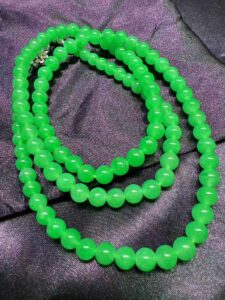


The most expensive jadeite necklace ever sold is a string of twenty-seven green beads. No diamonds to speak of, no great designer’s signature on the stones themselves. Twenty-seven beads, graduated from 15.4 to 19.2 millimetres, and a clasp. In April 2014 it sold at Sotheby’s in Hong Kong for 27.44 million US dollars, and the room that afternoon included some of the most experienced jewellery buyers alive, bidding against each other for twenty minutes over what is, structurally, the simplest form of jewellery there is.
The necklace is called the Hutton-Mdivani. The beads are old; the story goes that they came out of the Qing court, and nobody has ever been able to say precisely when or how. What is documented begins in 1933, when the Woolworth heiress Barbara Hutton married Prince Alexis Mdivani and received the strand from her father as a wedding gift. She was twenty. Cartier made the clasp, then remade it a year later in yellow gold with calibre-cut rubies and baguette diamonds, which is the version the world knows. Hutton owned famous diamonds and famous emeralds, and outlived most of her fortune. The beads stayed.
They surfaced at auction in 1988 and made two million dollars, a record for jadeite at the time. In 1994 they sold again for 4.2 million, another record. By 2014 the estimate had grown to 12.8 million, and the hammer more than doubled it. The buyer was Cartier itself, purchasing the necklace back for its own collection, which is roughly what it looks like when a jewellery house decides an object belongs to history rather than to commerce.
Here is what the money was actually for. Finding one bead of that colour, translucence and size means finding a boulder with a clean passage large enough to waste most of it. Finding twenty-seven that match, in an age before the mines were industrial, means someone spent years, possibly decades, setting aside stones that agreed with each other and rejecting hundreds that almost did. The carving on that necklace is invisible because the carving is the matching. It is the most patient object in the history of the trade.
We keep a much humbler version of that discipline alive in our own bead bracelets, where every strand is matched by hand for tone and water before it is strung. Twenty-seven imperial beads are not on offer. The habit of refusing the bead that almost matches is the same habit, practised at a scale a person can actually own.