

Ask an old hand where a piece was carved and the answer usually names one of the four great jade carving schools: Jieyang, Sihui, Su-Yang, or Ruili. Each grew up around a different question. Jieyang asked how finely the very best stone could be worked. Sihui asked how a whole town could live by the chisel. Su-Yang inherited the scholar’s taste of the Yangtze cities. And Ruili, on the Burmese border, asked the first question of all: what is actually inside this boulder? Our studio belongs to the fourth tradition, so we will try to be fair to the other three.
Jieyang: precision above everything
The workshops of Yangmei village in Jieyang, Guangdong, took the top of the market and kept it. Yangmei is a village in the administrative sense only; in practice it is a single organism of workshops where a large share of the world’s finest jadeite goes to be cut, and where owners of important rough will queue, sometimes for months, for a particular bench. The local standard tolerates nothing less than exact symmetry, knife-clean lines and a finish that survives a loupe. A Jieyang guanyin or leaf is often the most technically perfect object its stone could have become. The price of that perfection is temperament; the style serves flawless material best, and flawless material is what Jieyang insists on being sent.
Sihui: the industry
Sihui, also in Guangdong, is the trade’s engine room. Streets of workshops, tens of thousands of carvers, and the famous tianguangxu, the “daybreak market,” where finished pieces change hands by lamplight before the sun is properly up. In recent years the livestream studios moved in beside the carving benches, and a piece can now be carved, lit, sold and boxed within the same hundred metres. The range runs from ornaments turned out by the crate to genuinely fine work, and the honest summary is that Sihui is where the world’s everyday jade comes from. Without it, jade would only be a rich person’s stone. That is not a small contribution.
Su-Yang: the scholar’s line
Suzhou and Yangzhou carved for the literati long before jadeite reached China, and the taste survived the change of stone: restraint, negative space, subjects from landscape and poetry rather than the luck-and-wealth catalogue. The signature of the line is the Yangzhou mountain carving, the shanzi: an entire landscape kept inside one boulder, a path switchbacking past pines to a pavilion the size of a fingernail, with most of the stone deliberately left silent around it. It is carving that behaves like ink painting, down to the empty space doing half the work. When a modern piece feels like a scroll rather than a charm, its manners usually trace to Su-Yang.
Ruili: where the stone arrives first
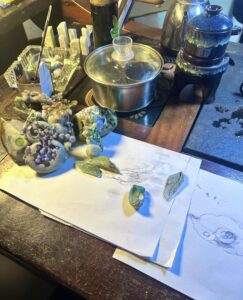
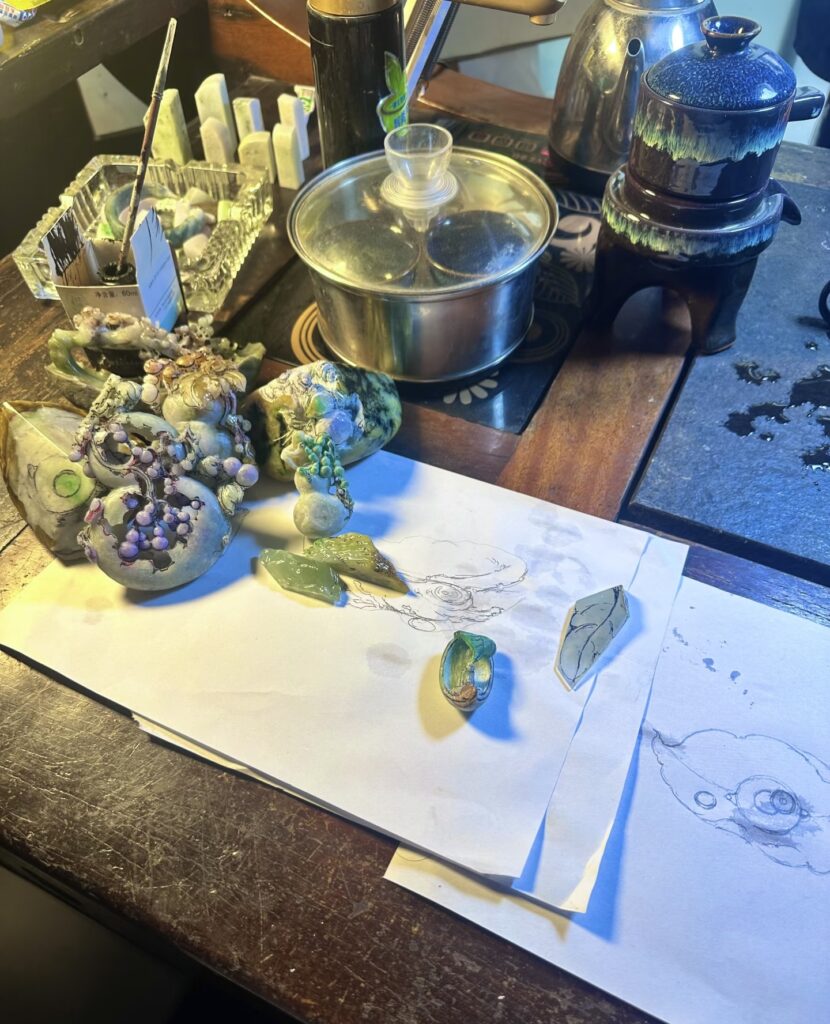
Ruili sits on the Yunnan side of the China–Myanmar border, which means every boulder of Burmese jadeite passes its doorstep before it passes anyone else’s. In the rough markets around the Jiegao border gate the day starts early: stones laid out in rows with their little polished windows, torchlight moving over wet skin, prices agreed in gestures older than the buildings. The town’s craft grew out of that position. A Ruili carver learns to judge rough alongside the traders, to cut for the stone’s best passage rather than for a pattern book, and to work material at every grade because every grade walks through the gate. The style that results is pragmatic and stone-led; letting the colour decide the subject, what the trade calls qiaose, is everyday practice here rather than a special effect. It is the tradition this studio was raised in, four generations deep, and the reason our pieces are described stone-first.
One boulder, four fates
Imagine a middling boulder: decent green in one lobe, a crack running through the other, nothing imperial. Send it to the four towns and you get four different objects. Jieyang would likely decline it; the material does not justify the bench time, and the bench has a reputation to keep. Sihui would open it in the morning and by evening have cut a dozen sound pendants around the crack, priced for people who want real jade this year rather than perfect jade someday. A Su-Yang hand might do the strangest thing: keep the crack, and carve it into the ravine of a mountain, so that the flaw becomes the landscape’s oldest feature. And Ruili would sit with it by the window for a week, then carve toward the green, letting the colour choose the subject and the crack fall away with the waste. None of these answers is wrong. Held side by side, they are the four schools, explained better than any definition manages.
Does the school matter to a buyer?
Less than the stone, more than nothing. A certificate tells you the jadeite is real; the school tells you what the maker was optimising for. If you want maximum finish on maximum material, that is Jieyang’s promise. If you want value at every level, Sihui delivers it. If you want quiet, literary taste, look for the Su-Yang hand. And if you want the piece designed around what the stone was already doing, that is the border tradition, and it is ours. Whatever the school, the fundamentals in our guide on how to tell real jadeite apply unchanged, and the forms themselves are explained in the shapes glossary.